
How to Plan for Retirement

When you picture retirement, what comes to mind? Maybe it’s traveling to places you’ve always wanted to see, spending quiet mornings with family, or simply having the freedom to spend your time exactly how you choose.
Whatever your vision looks like, one thing is clear: retiring comfortably doesn’t happen by accident. It is an ongoing process that works best when you start years, or even decades, before you hand in your notice. Building a solid financial plan gives you control over your timeline, helps cushion your savings against market surprises, and is designed to help you enjoy life today while actively preparing for tomorrow.
Why Retirement Planning Matters More Than You Think
It’s easy to push retirement planning off to the “someday” pile, especially when day-to-day life is full of immediate expenses. But starting early is the single best favor you can do for your future self.
Why? Because of compound growth—essentially, the interest you earn on your interest. Think of it as putting your money to work so you don’t have to work forever.
Data from the Vanguard Center for Investor Research shows just how powerful time can be. Consider a hypothetical comparison of two individuals saving the same monthly amount:
- Person A begins saving $500 a month at age 25. Based on a mathematical projection assuming a 7% average annual return, the account balance reaches approximately $1.2 million at age 65.
- Person B waits until age 35 to begin saving $500 a month. Using the same 7% hypothetical return model, the balance reaches approximately $567,000 by age 65.
Person A ends up with more than double the wealth simply because they gave their money ten extra years to grow. It’s a clear reminder that when it comes to building wealth, time in the market often matters far more than trying to time the market.
Proactive planning also helps keep inflation from quietly shrinking your hard-earned savings. The Bureau of Labor Statistics (BLS) notes that historical inflation averages around 2% to 3% each year. If your money just sits in a basic savings account, it gradually loses buying power, meaning a dollar tomorrow won’t buy what a dollar buys today. A well-designed investment plan helps your money keep up with the real cost of living over a 20- to 30-year retirement.
What Are the First Steps of Retirement Planning?
If you’re wondering where to start, take a breath. You don’t need to figure out every detail all at once. Getting your bearings starts with four straightforward steps:
- Picture your post-work life: When do you want to retire? Where do you want to live? Will you travel extensively, pick up new hobbies, or keep things simple at home?
- Estimate your basic living costs: Break your potential expenses into two buckets: the “must-haves” (housing, healthcare, food) and the “nice-to-haves” (travel, hobbies, dining out).
- Take stock of what you have: Gather up statements from all your current accounts: 401(k)s, IRAs, taxable brokerage accounts, pension details, and your estimated Social Security benefits.
- Spot the gap: Compare what you’re projected to have against what you’ll actually need each year. That difference is your target, giving you a clear focus for your savings strategy.
How Do You Plan for Retirement?
As you move through your career, your focus naturally shifts. You move from the accumulation phase (building your nest egg) to the transition phase (protecting what you’ve built), and finally to the distribution phase (turning your savings into reliable income).
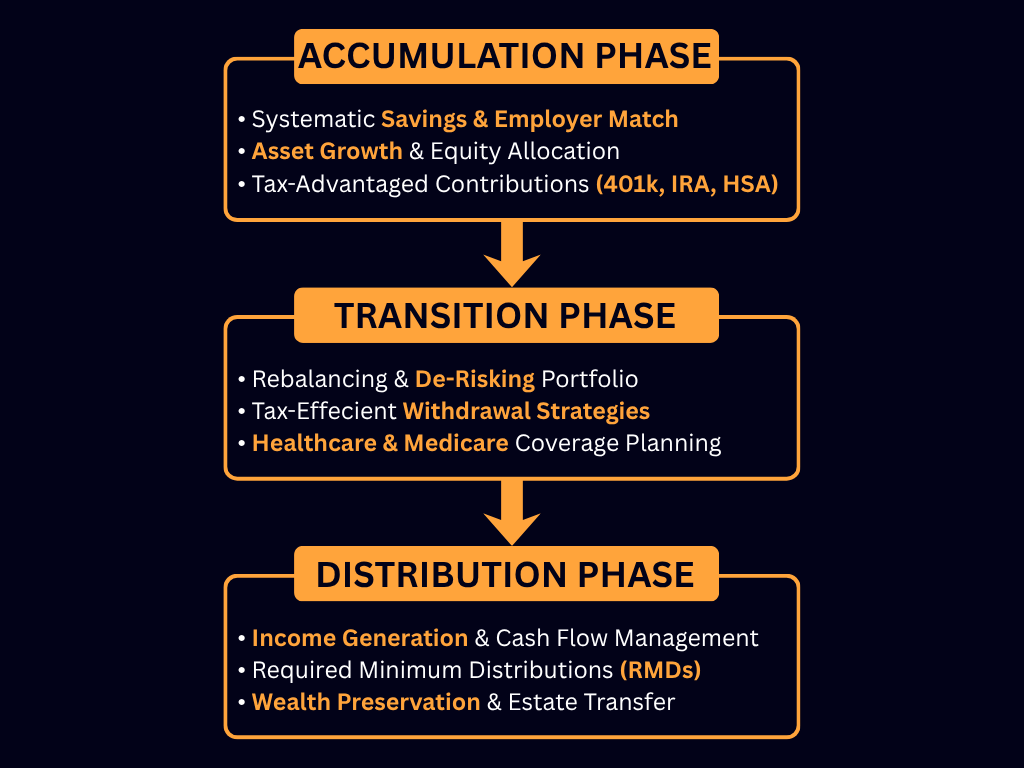
To bridge these phases successfully, you’ll want to balance five key areas:
- Investments: Matching your mix of assets to your personal risk comfort and timeline.
- Taxes: Structuring your withdrawals so you aren’t paying more in taxes than necessary.
- Insurance & Healthcare: Safeguarding your wealth against medical surprises.
- Risk Management: Shielding your portfolio from deep market dips and liquidity crunches.
- Estate Planning: Ensuring your legacy reaches the people and causes you care about most.
Building a Comprehensive Retirement Strategy
Determining How Much You’ll Need
A popular starting rule of thumb is aiming to replace 70% to 80% of your pre-retirement income to maintain your current lifestyle. But because everyone’s situation is unique, you’ll want to fine-tune that number around a few real-world factors:
- Debt & Lifestyle: Paying off your mortgage before you retire drops your monthly needs significantly. On the flip side, plans for frequent travel or managing a second home will push that baseline up.
- Healthcare Realities: Healthcare is often one of the biggest surprises for new retirees. The Fidelity Retiree Health Care Cost Estimate estimates that a 65-year-old retiring today may need around $172,500 saved just to cover medical expenses throughout retirement—and that doesn’t include long-term care.
- Your Timeline (Longevity): People are living longer, healthier lives. Data from the Society of Actuaries shows that a healthy 65-year-old couple has a 50% chance that at least one spouse will live to age 92. Planning for a 30-year retirement ensures you won’t outlive your money.
- Social Security Strategy: When you claim Social Security matters a lot. If you wait until your full retirement age (age 67 for those born in 1960 or later), you receive 100% of your earned benefit. But if you can afford to delay claiming until age 70, your monthly payout grows by roughly 8% every year you wait.
Choosing the Right Investment Mix
Your investment strategy should naturally evolve as you get closer to your target retirement date.
- Asset Allocation: Early on, leaning into equities (stocks) helps drive growth. As retirement nears, shifting a portion into fixed income (bonds) and cash offers stability.
- Diversification: Spreading investments across different industries, company sizes, and geographic regions keeps one underperforming sector from dragging down your whole portfolio.
- Understanding Risk Capacity: It’s one thing to tolerate market swings emotionally on paper; it’s another to handle them when you’re actively pulling living expenses out of your account.
- Sequence of Returns Risk: Bad market downturns in the first few years of retirement can do outsized damage if you are forced to sell assets at a loss. Shifting toward more stable assets as you approach your retirement date helps insulate you against that risk.
Note: Diversification and asset allocation strategies help manage risk, but they do not guarantee a profit or protect against loss in declining markets.
Tax Planning and Preserving Your Wealth
How much you keep matters just as much as how much you make. Building a mix of account types gives you flexibility when it comes time to draw an income:
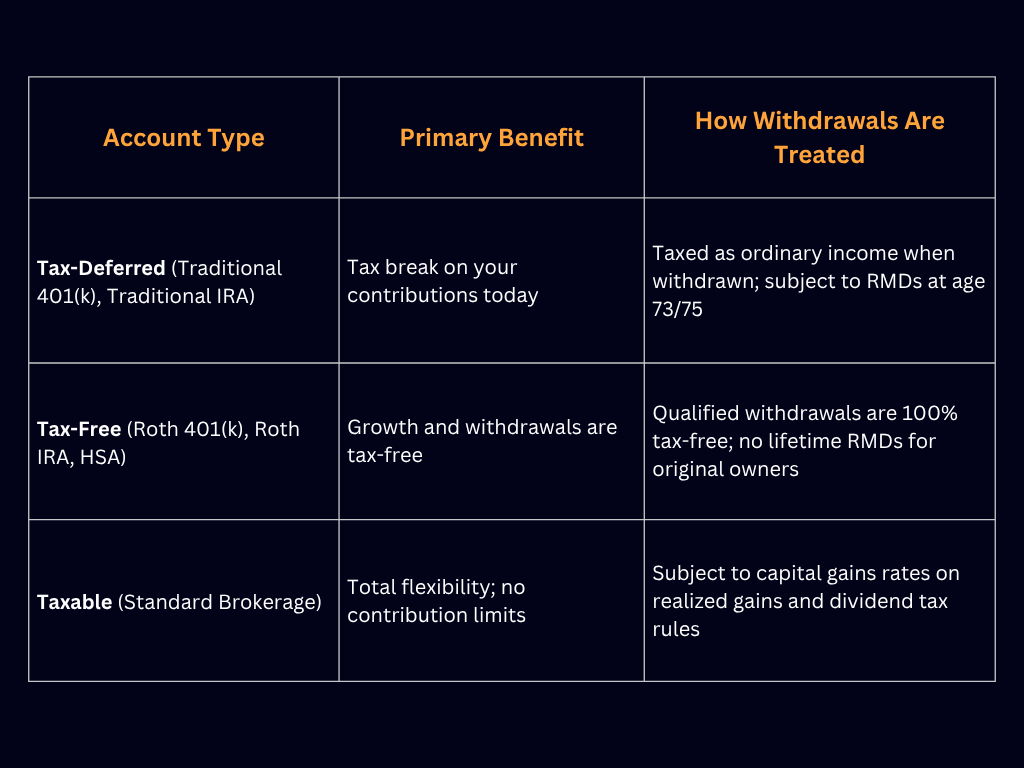
- Exploring Roth Conversions: Converting portions of a traditional IRA into a Roth IRA during lower-income years lets you pay taxes now at a lower rate, creating a pool of tax-free income for the future while reducing future Required Minimum Distributions (RMDs).
- Smart Withdrawal Sequencing: Drawing strategically from taxable, tax-deferred, and tax-free accounts each year allows you to manage your tax bracket and keep more of your money working for you.
- Estate Planning Basics: Having up-to-date wills, healthcare directives, powers of attorney, and beneficiary designations ensures your wishes are honored and saves your loved ones from unnecessary legal headaches.
Simple Habits That Boost Retirement Readiness
Small, consistent moves today turn into huge advantages over time:
- Max out tax-advantaged accounts when possible: For 2026, the 401(k) contribution limit is $24,500 (plus a $8,000 catch-up if you’re 50 or older). IRAs allow up to $7,500 (plus a $1,100 catch-up for age 50+). Even if you can’t hit the max, try raising your contribution rate by 1% each year.
- Schedule an annual check-up: Set a calendar reminder once a year to review your portfolio balance, check investment fees, and make sure your savings goals are still on track.
- Pay down high-interest debt: Shedding high-rate credit cards or personal loans before you retire keeps your required monthly income lower.
- Stress-test your numbers: Take time to run a few “what-if” scenarios—like a sudden market dip, higher inflation, or an unexpected home repair—to see how resilient your plan really is.
- Work with a fiduciary advisor: Partnering with a fiduciary advisor gives you an objective partner whose job is to keep your best interests first while navigating complex tax and market decisions.
Common Mistakes to Keep on Your Radar
- Waiting too long to jump in: Postponing your savings habit by even five years means missing out on significant compound growth.
- Underestimating medical expenses: Assuming Medicare will cover every single health need is a common trap; it generally doesn’t cover long-term custodial care.
- Playing it too safe too early: Holding too much cash early in retirement can leave you vulnerable to inflation quietly eroding your purchasing power.
- Reacting to market headlines: Panicking during temporary market drops often leads to selling low and buying high, disrupting your long-term growth.
- Forgetting about tax flexibility: Keeping all your savings in a single account type leaves you with fewer options to manage taxes once you start taking withdrawals.
Taking Your Next Step
A great retirement isn’t something that just happens—it’s built step by step through clear goals, steady habits, and a strategy that adapts as your life changes.
At Insight Wealth, we take the guesswork out of retirement planning. We work alongside you to create a personalized, tax-efficient strategy designed to protect what you’ve built and give you confidence in the road ahead. Reach out to our team today to review your current setup and start building a path toward your ideal retirement.
Insight Wealth Strategies, LLC is a Registered Investment Adviser. Advisory services are only offered to clients or prospective clients where Insight Wealth Strategies, LLC and its representatives are properly licensed or exempt from licensure. Past performance is no guarantee of future returns. Investing involves risk and possible loss of principal capital. No advice may be rendered by Insight Wealth Strategies, LLC unless a client service agreement is in place.
Insight Wealth Strategies, LLC (IWS) and its affiliates do not provide tax, legal or accounting advice. This material has been prepared for informational purposes only, and is not intended to provide, and should not be relied on for, tax, legal or accounting advice. You should consult your own tax, legal and accounting advisors before engaging in any transaction.
Reviewed by,

Chad Seegers, CRPC®
Managing Partner/Investment StrategistRelated Blogs

Retirement Stress Testing: Build a Resilient Financial Plan

The Fed Just Raised Rates: What It Means for Your Money

The One Big Beautiful Bill Act: 2027 Tax Planning Priorities for You

Smart Wealth Growth Strategies for Executives in a Shifting Market

How to Overcome Your Financial Fears About Retirement
Stay informed with our latest insights on
wealth management for pre-retirees.
Subscription Form
Ready to plan your retirement transition?
The decisions you make in the next few years will determine your retirement lifestyle. Let’s create a plan that gives you confidence in your financial future.